
Hibs and Hearts: the Origins of their Rivalry
The origins of both Hearts and Hibs lie in Edinburgh’s Old Town and South Side. Much of Walter Scott’s novel Heart of Midlothian was located in St Leonards/Pleasance/ Dumbiedykes and it was young men from those areas and the Cowgate/South Back of Canongate (now Holyrood Road) that founded both clubs. The chances are that most of the players knew each other, by sight at any rate. Did such familiarity breed contempt?
Prior to their formation, there had been clubs playing a hybrid of the game on the Meadows, most notably Blue Bonnets and White Star, and when the Association game got off the ground in Edinburgh in 1874, first with the 3rd ERV, followed by the Thistle, the former teams folded and their players migrated to other start-ups, Hanover, Swifts, Hearts and Hibs over the next 12 months.
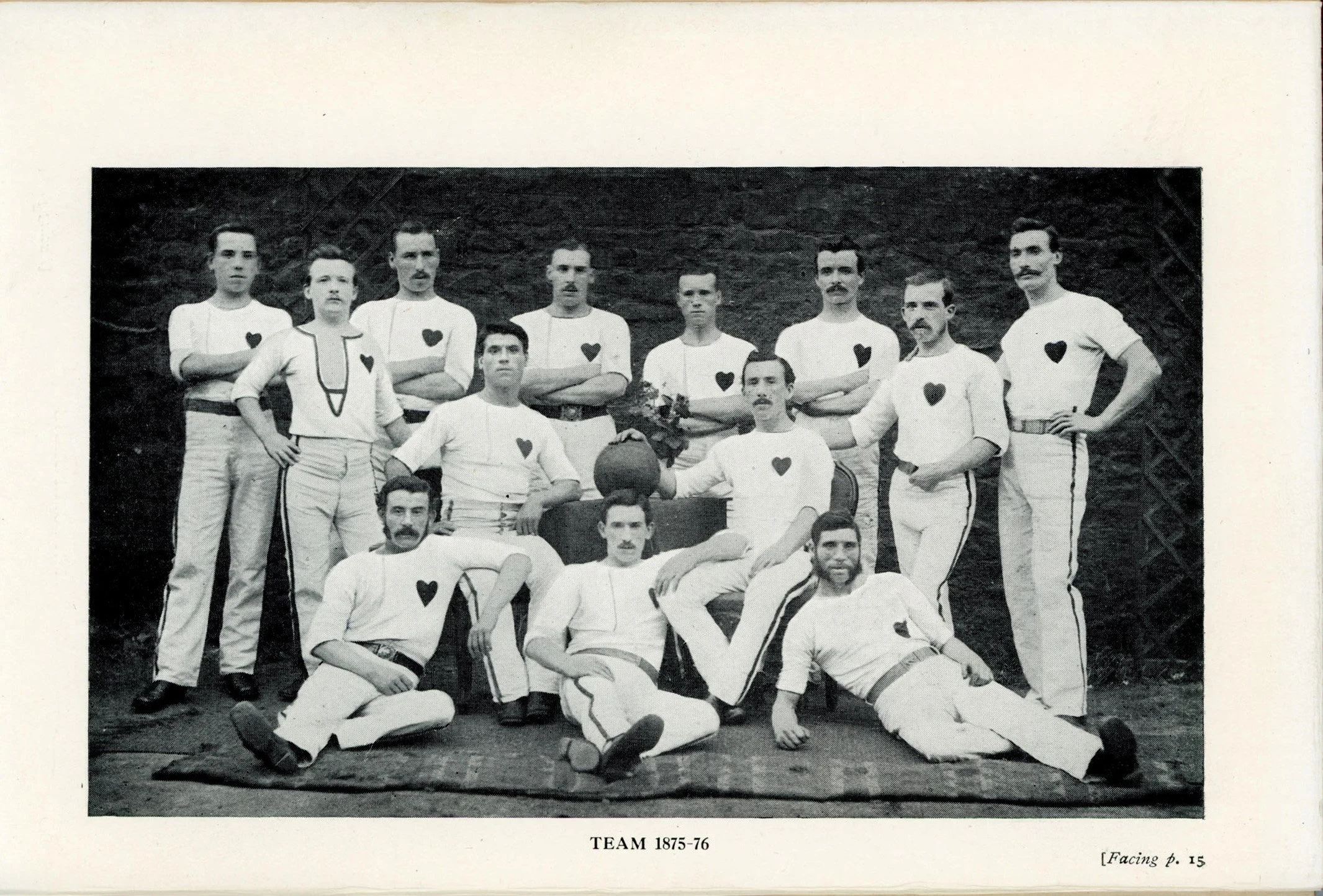
Hearts were probably founded in 1874, possibly even 1873, though they could not then have been playing to Association rules. Perhaps because of this there are no known newspaper reports of their games. Their first recorded game is on 28th August 1875 when they went down 0-2 to the 3rd ERV. Hibs on the other hand were certainly formed only a few weeks before that Hearts game, on 6th August 1875, because it is recorded in the minute books of the parent organisation the Catholic Young Men’s Society (CYMS). But no Hibs games are reported on for several months.
The legend runs that a few of the refugees from White Star, namely Michael Whelahan, Malachy Byrne and Andy Hughes, approached the CYMS chaplain Fr Hannan to seek permission to start a CYMS team. Hughes’ father had been the first secretary of the CYMS and a therefore a close confidant of Hannan. Rules were published showing Byrne as secretary. Meetings were to be held in Buchanan’s Temperence hotel (now the Radisson) in the High Street. The next mention of Hibs anywhere is in the 6-line report in the Scotsman of 27th December of a match on the Meadows between Hibs and Hearts on Xmas Day 1875. The names of only Cavanaugh and Byrne for Hibs are mentioned; Wylie and Laidlaw for Hearts.
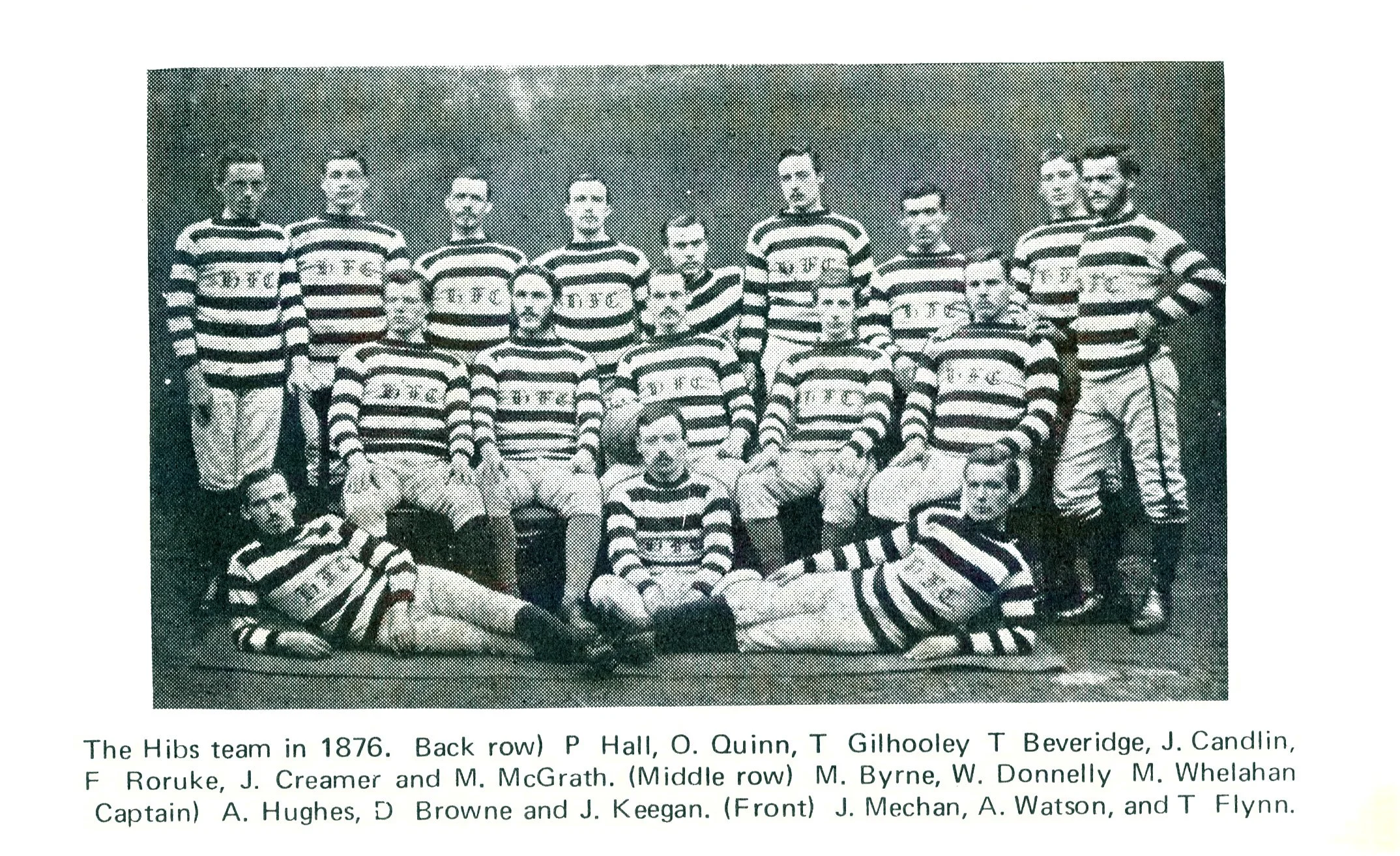
A famous cartoon by Frank Boyle commemorates the occasion. There are a few details worth mentioning. First, the spectators. The priest Fr Hannan, Irish navvies and a woman with an Irish flag stand together with some interested Edinburgh bystanders, a police constable, a lamplighter and author Robert Louis Stevenson. Then the strips. Whilst the Hearts one could be correct – there is an 1875 photo of the team in white shirts with a heart sewn on the left breast, and it is thought that they didn’t adopt the red/white/blue colours and then maroon till 1876 – the Hibs one is questionable. The Hibs first rules published only a few months earlier said their uniform would be white guernsey with a harp on the left breast, so it is unlikely that they would have adopted the hoops within months. Those probably came at the start of the 1876-77 season, perhaps as Hibs joined the EFA and SFA, and there are a couple of photos in existence of the team in hoops dating from 1876 and 1879.
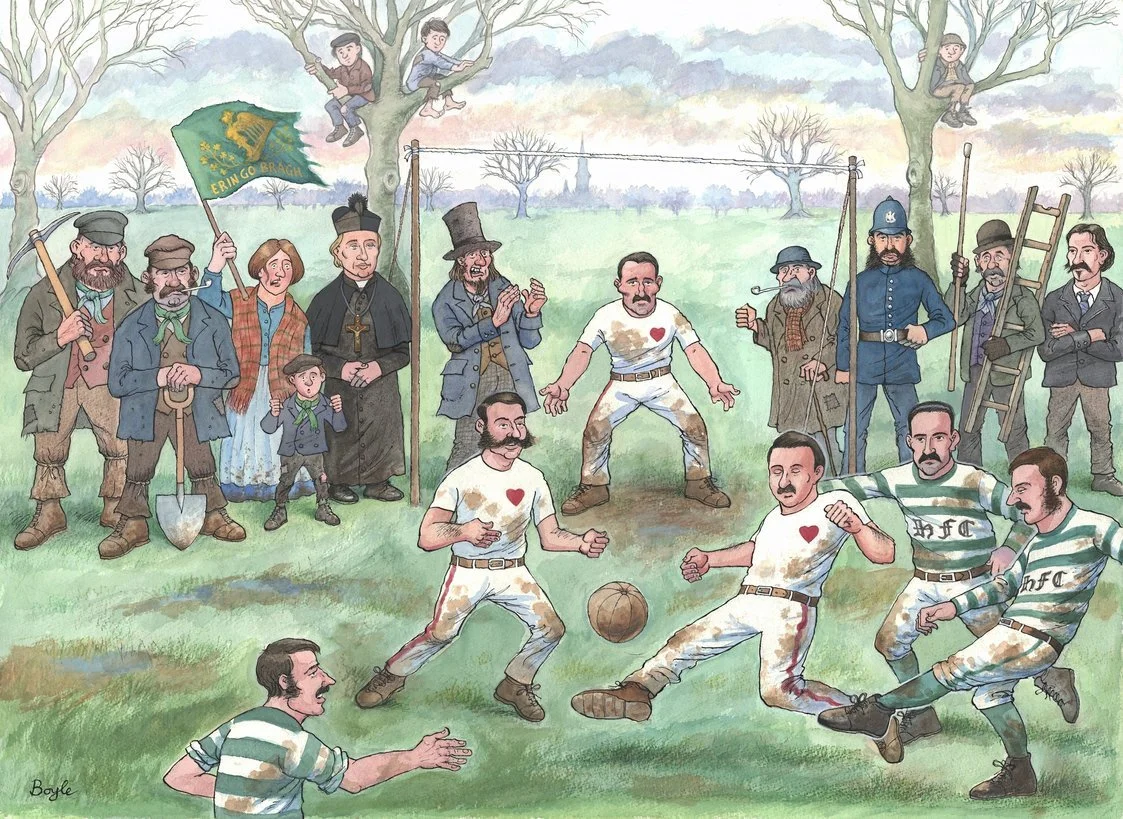
Reproduced with the permission of Frank Boyle - see Sources below
But both teams couldn’t have played in white on Xmas day, could they ? Another possibility is that Hearts played in a hooped red, white and blue strip (with “MFBC” - some think this stood for Midlothian Foot Ball Club but to my knowledge it has never been adequately explained - across the chest in exactly the same place where “HFC” is shown on the Hibs strip in the cartoon). There is another early Hearts team photo showing them wearing such a strip, though obviously one can’t determine the colours. This strip was worn by the original Hearts before they merged with St Andrews ( see below ) in late 1876. Hearts bought their early kits from Percival King’s workshop in Lothian St, and it would be no surprise if Hibs had done the same, copying the Hearts hooped design before they joined the EFA.
Xmas day was not a holiday in Presbyterian Scotland. In 1875; it happened to fall on a Saturday, hence the game was played that day. But the Catholic Hibs players would have been expected to attend midnight mass the evening before, giving them a perfect excuse for losing next day, despite playing against 8 men for the first 20 minutes. As temperance was a condition of CYMS membership, they did not have the excuse of a hangover.
That the game in question was the first has also been challenged. What were Hibs doing between their formation in August 1875 and the Xmas day game? Presumably playing friendlies since they were not in any cup competition. But against whom? There were very few Association code teams and the EFA/SFA discouraged their members from playing Hibs. The pioneers 3rd ERV were run by the anti-Catholic lawyer John Hope, and one detects his hand at work. Albert Mackie’s book The Hearts reports an early Hearts player, John Cochrane, interviewed in the 1930s as saying there was a Hearts v Hibs match several months earlier which Hearts won 3-1. Cochrane’s memory may be questionable though, since he at the time was playing for the St Andrews club which merged with Hearts only in the autumn/winter of 1876-77. Either way, it was Hearts who broke ranks with the EFA and volunteered to play Hibs on Xmas Day 1875. An act of friendship.
Hibs did play friendly matches against some of the other EFA teams in season 1875-76, notably Hanover and Thistle, who defied EFA guidance, and by September 1876, despite Hope’s efforts, had been accepted by the EFA and shortly after, the SFA. It is only after this, for a match against the Thistle on 14th October that the full Hibs team is listed. It is worth mentioning that the Hibs Historical Trust is currently putting together thumbnail sketches for each of the early players and officials. Early work using the 1881 census suggests that the players were not unemployed Irish peasants as some have been keen to paint them, but working or lower middle class young men, mostly employed in local industry or crafts. And hardly undernourished since you had to be able to run around a football pitch for more than an hour.
Paradoxically, in the autumn of 1876, as Hibs were joining, Hearts’ membership of the EFA lapsed since they were unable to recruit enough players, though they did retain their membership of the SFA. They played an under-strength side against St Andrews, lost, and then 3 of their better players, Purdie, Wylie and Mitchell approached St Andrews with a view to joining them. The story goes that Mitchell persuaded St Andrews to adopt the Heart of Midlothian name and Hearts were then able to rejoin the EFA. Hearts had by that time been wearing Red, White and Blue, and St Andrews wore Blue. Legend says that when the strips were washed together, they became maroon. More likely the clubs just agreed on maroon as the best compromise colour. So the local rivalry could resume, and Hibs played the new Hearts team in friendly games a couple of times in the spring of 1877.
The teams met several times thereafter in cup competitions (there was no league) and friendlies in the subsequent years, most famously in the Edinburgh Cup final of 1878 which went to 4 replays before Hearts won it by the odd goal in five at Powburn, and captain Purdie was chased by irate Hibs fans and had to take refuge in a house in Causewayside. The rivalry was clearly becoming less friendly.
Powburn was one of many grounds used by the capital teams when the Meadows became overcrowded, others being Powderhall and in Hibs case, Mayfield. By 1880 however, Hibs had found a new home, Hibernian Park, just off Easter Road, and the following year Hearts moved to Dalry to create the geographic divide in the city that exists to this day.
In a further sign of deteriorating relationships, in 1880, Hearts attempted to have Hibs expelled from the EFA for the rough play of their players and their fans’ aggressive behaviour. Their attempt failed, but only due to the casting vote of the chairman.
Hibs dominated the Edinburgh scene for the decade to 1887 with Hearts very much second best. Hibs access to the best Catholic and Irish players in Scotland prompted Hearts to make underhand payments to stop the flow of Scottish players to clubs in the North of England. They were caught and suspended from the EFA for around a month in late 1884.
By the end of the decade, roles were reversed and as Hibs lost their best players to the newly formed Glasgow Celtic and the lease on Hibernian Park could not be renewed, they went into Hibern(ianis)ation, and Hearts became the capital’s premier club.
Sources
1. Frank Boyle. Website is www.boylecartoon.com Instagram : @boylecartoon
The print is available for purchase at frankboyleart.bigcartel.com
2. Albert Mackie, The Hearts - the Story of Heart of Midlothian F. C.
3. Mike Hennessy, Edinburgh’s First Hibernian: The Mission of Edward Joseph Hannan
https://www.thirstybooks.com/bookshop/edinburghs-first-hibernian